The following was a project for SOCJ5016: Globalizing Families and Reproductive Rights at Lakehead University during the summer of 2023
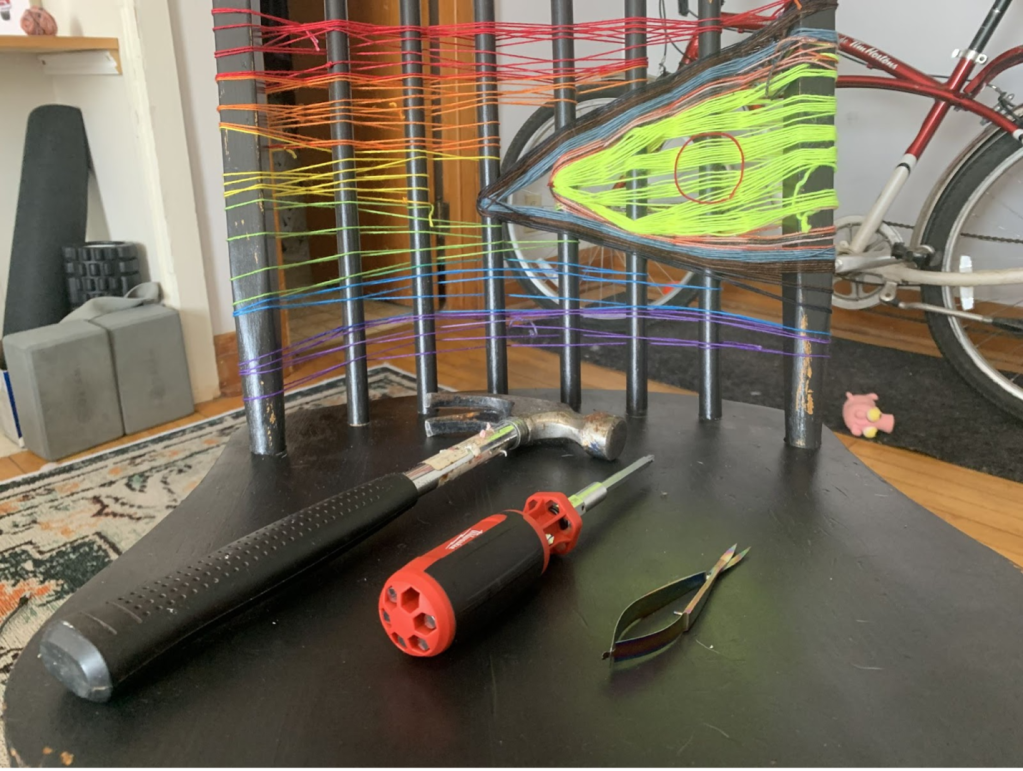
An image that has stuck in my mind throughout recent feminist readings was Marilyn Frye’s conception of oppression as a birdcage (43). If we take a narrow focus and look at one wire of the cage, why would a bird not fly around it? There’s nothing about the individual wires of a cage that trap a bird, just as a single sexist remark doesn’t oppress all women at once, but when we take a step back, we can see the systematic enclosure.
My seminar and essay both discuss(ed) enclosure: the seminar focused on the one-by-one examination of cases justified through narratives of saving, but ultimately remaining enclosed in and replicating exploitation. My essay takes this more literally with glass wall enclosures, surveillance, and while I tried to integrate resistance through Jane’s smashing of a bottle (Ramos 219-220), the connection I eventually came to was of the glass ceiling–broken by women who remained within the larger system of capitalist exploitation. But summer is here, and things have started growing in Thunder Bay, so I needed to find a way to envision resistance that worked for me. Overlooking my workspace, I have a postcard-sized collection of Audre Lorde’s work, the pastel mint cover reminding me in large font, The Master’s Tools Will Never Dismantle The Master’s House. In my explorations of storytelling and glass, I was looking at resistance within the context of the system but not stepping back to see the system in context, as Frye asks. Therefore, this project takes up Lorde and Frye’s ask to imagine the tools to dismantle the structure.
Threads were used as metaphors for connection throughout our course material (Arieff 9; Baldwin 245; Ramos 135; Syal 212, 274), and I began to envision Frye’s birdcage woven with the intersecting threads of oppression to hide and distract from the cage itself. This use of identity politics as a distraction came from my research into cancel culture and identity politics discourse, splicing apart groups that need to unite to make large-scale changes. This made me think: how can identity, a core part of how we tell our stories and connect, be configured to unify?
I chose to weave the progress pride flag, which includes more identities than the classic rainbow flag, including race in the wedge alongside intersex and trans folks. A focus on gender identity felt important not only in the context of this course, but also in the metaphorical sense of weaving around a structure–as unavoidable structures have shaped the lives of women, queer folk, and people of colour, so identity is built in the space created and taken back. As I began weaving the flag, I considered my tools–I wasn’t using a heddle loom, so I couldn’t remove this piece from the chair without going in and adding warp strings; however, the symbolic message I wanted to get across would be to remove the cage with the tapestry that unites us. I have a fancy pair of embroidery scissors from Tula Pink that began to symbolize individual market interventions: I could cut the woven strings by myself, remove the weaving mostly intact but ultimately damaged, and be able to view the larger cage of oppression, envisioned through the bars on the chairback. But I would never be able to use this tool to take down the larger structure: the delicate scissors would snap, just as market-based interventions uphold and rationalize the market itself: ‘shopping with my dollar’ only goes so far.
I have a hammer that would make quick work of the chair–I could probably stab it into the weaving, decimating the cloth, or swing or pry and break the chair to splinters. This is how I imagine revolutions which replicate the status quo, just with new individuals in charge–the revolution without getting to know each other and envisioning a shared future–thereby replicating harm and splintering the unity created through craving some sort of change. I’m reminded of Ahmed’s theorizing in “An Affinity of Hammers,” where the constant chipping at someone’s identity through microaggressions can break unity, while chipping together at a system can create unity (32). I could potentially use more delicate and focused chops to remove the chair bars, eventually removing the weaving intact. Focusing on the time spent together brought me to include the screwdriver my mother left behind when she helped me assemble this chair, its twin, and a matching table. I imagined unscrewing the chair bars and pulling them out with slow precision to keep the weaving intact. Of the three methods of dismantlement, wrapping around the bars and lifting them out felt the most powerful. There’s something about the movement of surrounding from all sides and using planning and precision to make change that feels exciting. This tool also reminded me of the importance of connection, relationships, and feeling (both tactile and emotional) in disrupting systems.
Though I plan to leave the chair as-is for a statement piece, creating this project got me thinking through how creation plays into dismantlement—two sides of a coin instead of opposites—as much as I want to go in swinging, taking the time to ground myself in creating shared futures and building relationships is a method of moving through destruction by creation. Large-scale relationships and understanding preclude hierarchy, violence, and authority, tools used for extraction and harm. This project has helped me understand the long-term work needed to work against a system prioritizing short-term thinking.
Works Cited
Ahmed, Sara. “An Affinity of Hammers.” TSQ: Transgender Studies Quarterly, vol. 3, no. 1–2, 2016, pp. 22–34, https://doi.org/10.1215/23289252-3334151.
Arieff, Adrienne. The Sacred Thread. New York, Random House, 2012.
Baldwin, Shauna Singh. The Selector of Souls. Toronto, Random House, 2013.
Frye, Marilyn. “Oppression” Bailey, Alison, and Chris J. Cuomo. The Feminist Philosophy Reader, edited by Alison Bailey and Chris J. Cuomo, McGraw-Hill, 2008, pp 41–49.
Lorde, Audre. The Master’s Tools Will Never Dismantle The Master’s House. London, Penguin Random House UK, 2018.
Ramos, Joanne. The Farm. New York, Random House, 2019.
Syal, Meera. The House of Hidden Mothers. New York, Sarah Crichton Books, 2017.
“What Is the Progress Pride Flag?” LGBTQ Nation, 24 June 2022, https://www.lgbtqnation.com/2022/06/progress-pride-flag/
 EMILY FAUBERT